

Description
The Plant
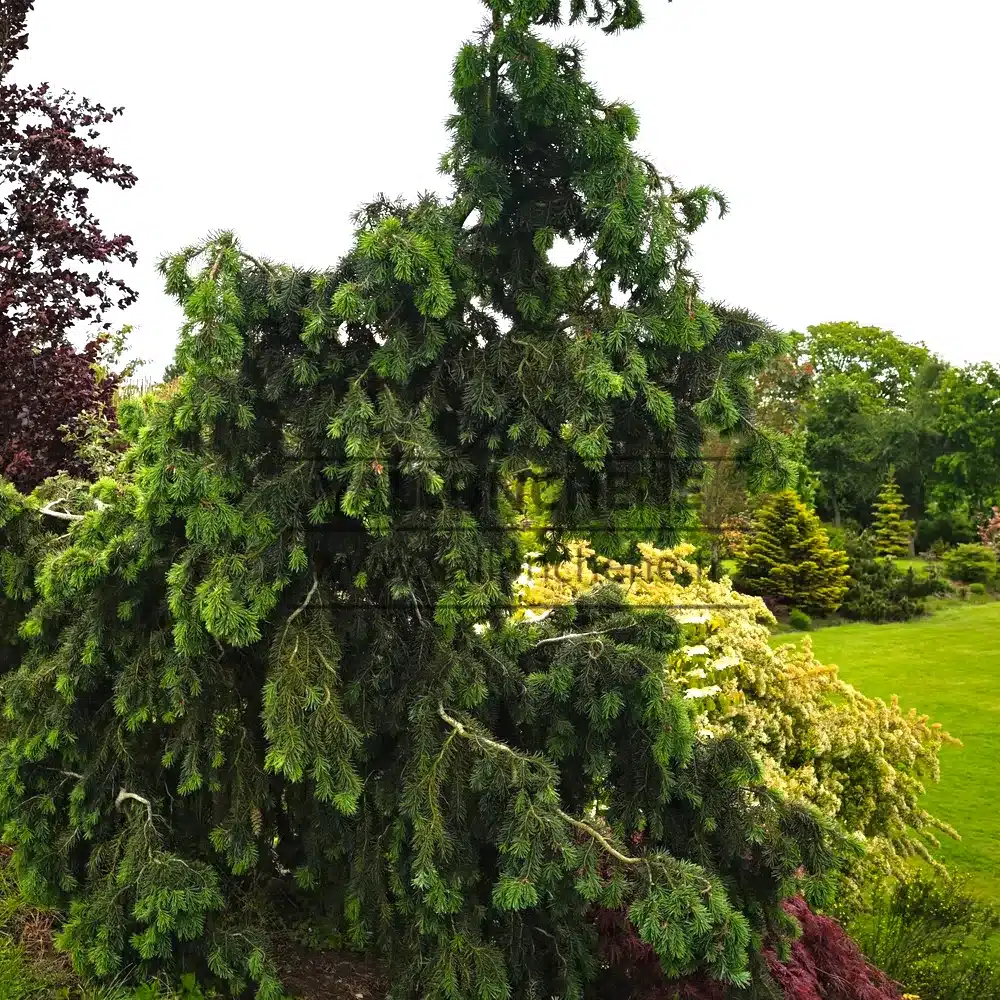
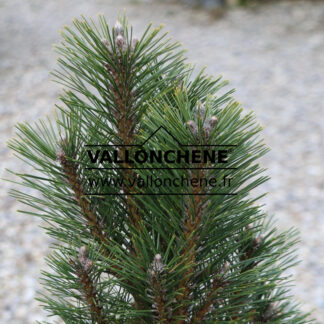
The PSEUDOTSUGA menziesii ‘Serpentine’ is a Douglas fir that can be described as a living sculpture. Its twisted, drooping branches give it a very particular appearance. Mother Nature has made it a masterpiece.
Indeed, if Douglas firs belong to the giants of the Pacific Northwest, the cultivar ‘Serpentine’ is distinguished by its dramatic and contorted silhouette. With its robe of bluish-green needles, it will not need to hide at the ball of natural beauties.
Then, compared to the giant typical species, the P. menziesii ‘Serpentine’ is a true dwarf. After a dozen years, it will not exceed 1.50 m (see photo of the specimen in the Vallonchêne Garden). This is related to the fact that the dominant central branch eventually twists and does not grow much in height.
In addition, this fabulous plant is frequently used in “gothic” landscapes and rock gardens as a focal point. It evokes a rather unique fairy-like atmosphere.
Of course, it is an extremely cold-hardy plant and perfectly suited to the art of Bonsai.
History and Origin
The type species, PSEUDOTSUGA menziesii, was discovered by Scottish explorers. It comes from North America.
Indeed, a Scottish naturalist named Archibald Menzies described this plant for the first time on Vancouver Island in 1791.
Then, in 1827, another Scotsman and legendary plant hunter, David Douglas, sent the first seeds to the United Kingdom. The common name is directly linked to his person.
The PSEUDOTSUGA menziesii ‘Serpentine’ represents a botanical selection from a genetic mutation. Most sources trace its origins to European nurseries around the end of the 19th and beginning of the 20th century. It seems to have been discovered by a French or German nursery.
Its lineage is related to the PSEUDOTSUGA menziesii f. pendula (weeping Douglas fir) while ‘Serpentine’ adds the tortuous effect.
How to plant and care for PSEUDOTSUGA menziesii ‘Serpentine’?
Planting
As mentioned above, this Douglas fir is a naturally very hardy plant. However, to give it the best chance of success, consider the following points:
- Find it a place in full sun or partial shade.
- The location can be humid, moderately humid or dry.
- It tolerates light, normal or heavy soil with an acidic, neutral or calcareous pH.
- For good preparation of the planting hole, we have designed specific instructions available here.
Care
As with all newly planted plants, follow regular watering for the first two years, especially during dry periods. Of course, watering will not take place during the winter. Also read our tips on how to water well and save water here.
Otherwise, the P. menziesii ‘Serpetine’ is an easy plant with no particular maintenance. However, if you wish to prune it, do so in February or March and before the new growth.



 7/7 from 8am-8pm


 Ask for a photo
Reviews
There are no reviews yet.