

Description
The Plant
Heptacodium miconioides is a type species that forms a very small, gracefully rounded tree, though it can also be grown as a shrub.
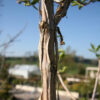
It is a remarkable plant offering year-round interest, developing light-toned bark that exfoliates in fine, papery strips.
Its deciduous foliage features a shape rarely seen in the plant world: it curves along its main central vein, almost forming a half-heart.
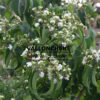
Then, in autumn, the floral display begins. The plant covers itself in an avalanche of fragrant white flowers, clustered in groups of six around a central bud—which is why it is known in English as the Seven-Son Flower. These blooms provide a vital food source for butterflies and bees during a season when flowers are exceptionally scarce (see the video).
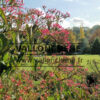
Once the flowers fade, an illusion of a second bloom unfolds: the persistent floral calyxes elongate and turn a striking cherry-red. This gives the distinct impression that the plant is flowering for a second time.
Finally, this plant has earned an AGM (Award of Garden Merit) from the RHS (Royal Horticultural Society) in the United Kingdom. To receive this award, a plant must undergo rigorous observation and trials—a testament to its exceptional garden qualities.
How to plant and care for HEPTACODIUM miconioides?
Planting
This very small tree is remarkably resilient. However, to optimize flowering and ensure successful establishment, keep the following points in mind:
- Choose a location in full sun or partial shade. The more direct sunlight it receives, the more abundantly it will bloom.
- The site can range from cool to moist, moderately moist, or dry.
- It tolerates very heavy, heavy, and average soils with an acidic, neutral, or alkaline pH.
- For proper preparation of the planting hole, we have created specific instructions available here.
Care
Heptacodium is exceptionally easy to grow. However, all newly planted specimens require regular watering during their first two years, especially during dry spells. Naturally, watering should be suspended during the winter months. Read our tips on how to water effectively and conserve water here.
This plant does not demand specialized care, but it tolerates pruning very well if desired. Pruning should be carried out in winter before new growth emerges.
Tip: To highlight its attractive bark, consider removing any thin, weak, or dead inner branches after a few years. This will allow you to fully appreciate its architectural display.
History and Origin
This type species represents a classic conservation paradox. While it thrives in cultivation across Europe and North America, it remains classified as vulnerable in its native habitat, where only a few fragmented populations survive.
In 1907, the renowned plant hunter Ernest H. Wilson discovered HEPTACODIUM miconioides during an expedition to China’s Hubei province. In 1916, it was formally classified by botanist Alfred Rehder based on Wilson’s dried herbarium specimens. The specific epithet miconioides was chosen because the leaf’s longitudinal veining resembles that of the tropical shrub Miconia.
The plant was then largely forgotten for nearly three-quarters of a century. In 1980, during a Sino-American botanical expedition, viable seeds were collected and brought to the Arnold Arboretum in the United States. The seeds successfully germinated, and the resulting plants were subsequently distributed to nurseries and botanical gardens.

 7/7 from 8am-8pm


 Ask for a photo

Reviews
There are no reviews yet.