

Description
LIQUIDAMBAR styraciflua ‘Golden Treasure’, the golden sweet gum
The LIQUIDAMBAR styraciflua ‘Golden Treasure’ is known by the common name sweet gum. This variety is a dwarf selection, of very slow growth and therefore of reduced mature size.
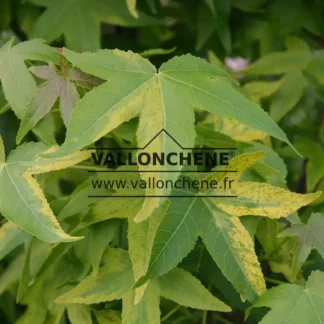
First, the LIQUIDAMBAR styraciflua ‘Golden Treasure’ unfurls star-shaped leaves with five lobes, green and edged in yellow. In addition, its dark brown bark fissures with age, forming beautiful lines of cork.
Then, in autumn, the lobes turn red, purple and pink, while the edges lighten. Later, small spiky capsules follow the inconspicuous flowers of spring.
Finally, its H6 hardiness rating makes it very hardy: it tolerates winters down to around -20 °C.
History and origin of the sweet gum
The species LIQUIDAMBAR styraciflua is native to the eastern part of North America. It is found from the banks of the Mississippi as far as Florida. Introduced to Europe around 1681, it has been grown there as an ornamental for three centuries.
The ‘Golden Treasure’ variety is a selection raised in Australia. It was introduced into trade in 1974 by the Duncan & Davies nurseries, in New Zealand.
Today, this small tree finds its place in many ornamental gardens.
Planting and care of LIQUIDAMBAR styraciflua ‘Golden Treasure’
Planting
This selection is easy to grow. Choose:
- a full-sun position, as it is this that brings out the most beautiful autumn colours.
- fresh to moist, well-drained soil, preferably acid to neutral and without lime.
- clay, loam or sandy soil, moderately fertile and enriched with organic matter.
Also protect it from strong winds. To prepare the planting hole, see our guide comment planter et entretenir les arbres, arbustes et conifères.
Care
Like any freshly planted plant, the LIQUIDAMBAR styraciflua ‘Golden Treasure’ needs regular watering for the first two years. Above all in dry periods, it should benefit from generous watering.
To succeed with this watering and save water, read our advice pour bien arroser le jardin et économiser l’eau.
Regular mulching around the trunk retains moisture and intensifies the colour of the foliage. In winter, watering stops: the plant needs no water at all during the cold season.
Here again, pruning is almost superfluous. A few branches to remove in winter are enough to keep a beautiful crown.
It is an ideal choice as a specimen tree in a medium-sized garden, in an orchard or in a park.

 7/7 from 8am-8pm


 Ask for a photo
Reviews
There are no reviews yet.