

Description
The Plant
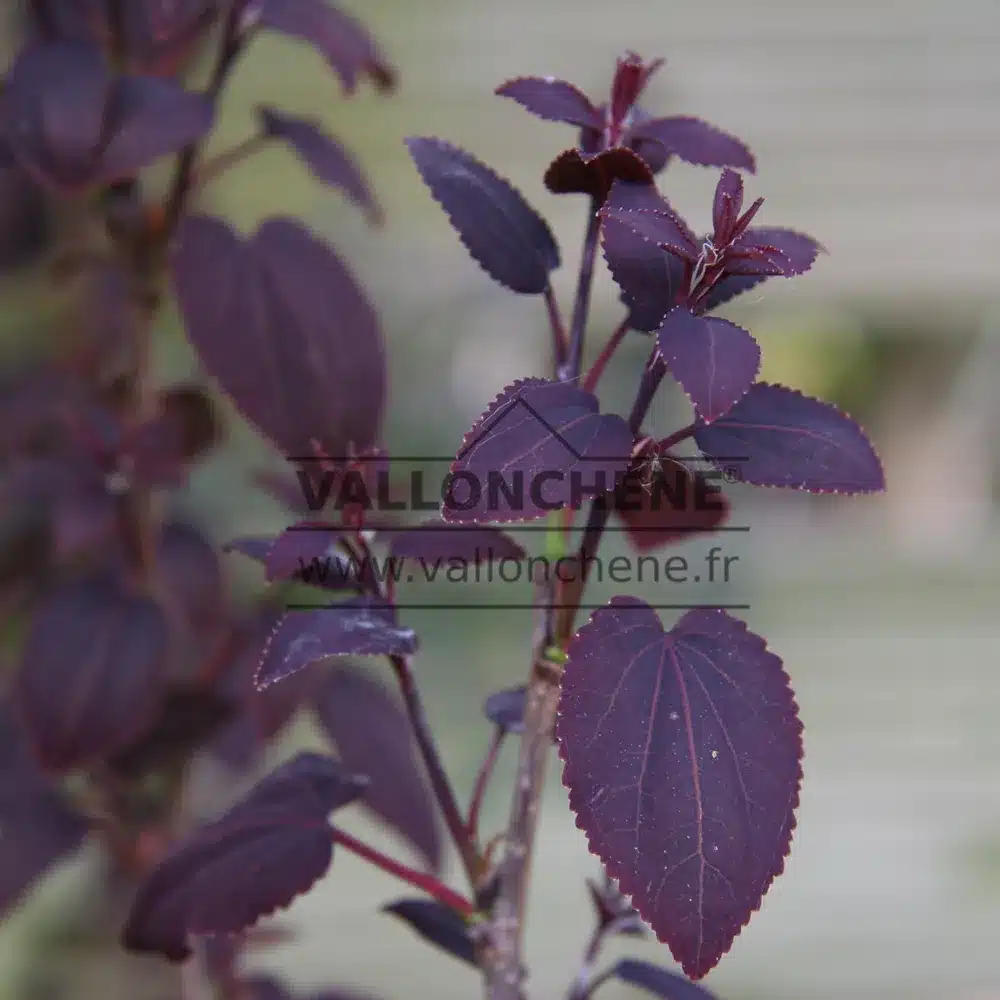
The CERCIDIPHYLLUM japonicum ‘Rotfuchs’ is a special Katsura tree. Indeed, its foliage and spring shoots are distinguished by a deep red, even burgundy, color. This is a rare phenomenon in general. Afterwards, it changes to a bluish-green color while the current year’s shoots retain their reddish coloration.
Then, this cultivar shows a narrow, columnar habit, while the typical species has a frankly rounded shape. Furthermore, this plant grows extremely slowly. Consequently, it will only reach a fraction of the height of the classic C. japonicum.
Moreover, its very vertical habit and small footprint, not exceeding 80 cm at most, make it an excellent choice for small spaces and gardens.
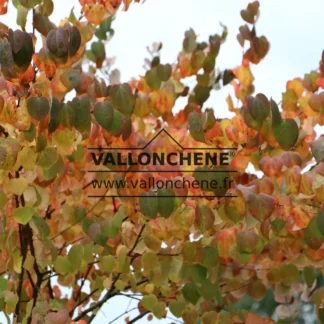
Finally, in autumn, the foliage of this mini Katsura tree changes color again to bronze and yellowish tones.
History and Origin
Unlike many recent selections, the CERCIDIPHYLLUM japonicum ‘Rotfuchs’ represents a happy find. In fact, it was part of a sowing carried out in the late 1970s by Karl Fuchs, a well-known German nurseryman based in Neunkirchen (Baden-Württemberg).
Moreover, the seeds came from a collection in the Exotenwald (exotic forest) in Weinheim, Germany. This is a renowned arboretum for its testing of foreign tree species, and has been since the 19th century.
The name ‘Rotfuchs’ is the German word for “red fox”. Therefore, this cultivar is also found in the English-speaking world under the name “Red Fox”.
This was an exceptional find, as CERCIDIPHYLLUM japonicum otherwise only exists with green foliage and an ample, rounded habit.
C. japonicum ‘Rotfuchs’ will be marketed more widely in the early 1980s. It remains one of the most sought-after cultivars among C. japonicum.
How to plant and care for CERCIDIPHYLLUM japonicum ‘Rotfuchs’?
Planting
CERCIDIPHYLLUM are very resilient plants. However, to give it the best chance of success, consider the following points:
- Find it a location in full sun or partial shade.
- The location can be cool to moist or normal. In truth, Katsura trees like cool soils in summer.
- It tolerates light, normal or heavy soil with an acidic, neutral or calcareous pH.
- For good preparation of the planting hole, we have designed specific instructions available here.
Care
All newly planted plants require regular watering for the first two years, and especially during dry periods. Of course, watering should not take place during the winter. Also read our tips on how to water properly and save water here.
If you wish to prune, do so in March before new growth.



 7/7 from 8am-8pm


 Ask for a photo
Reviews
There are no reviews yet.