


Description
The Plant
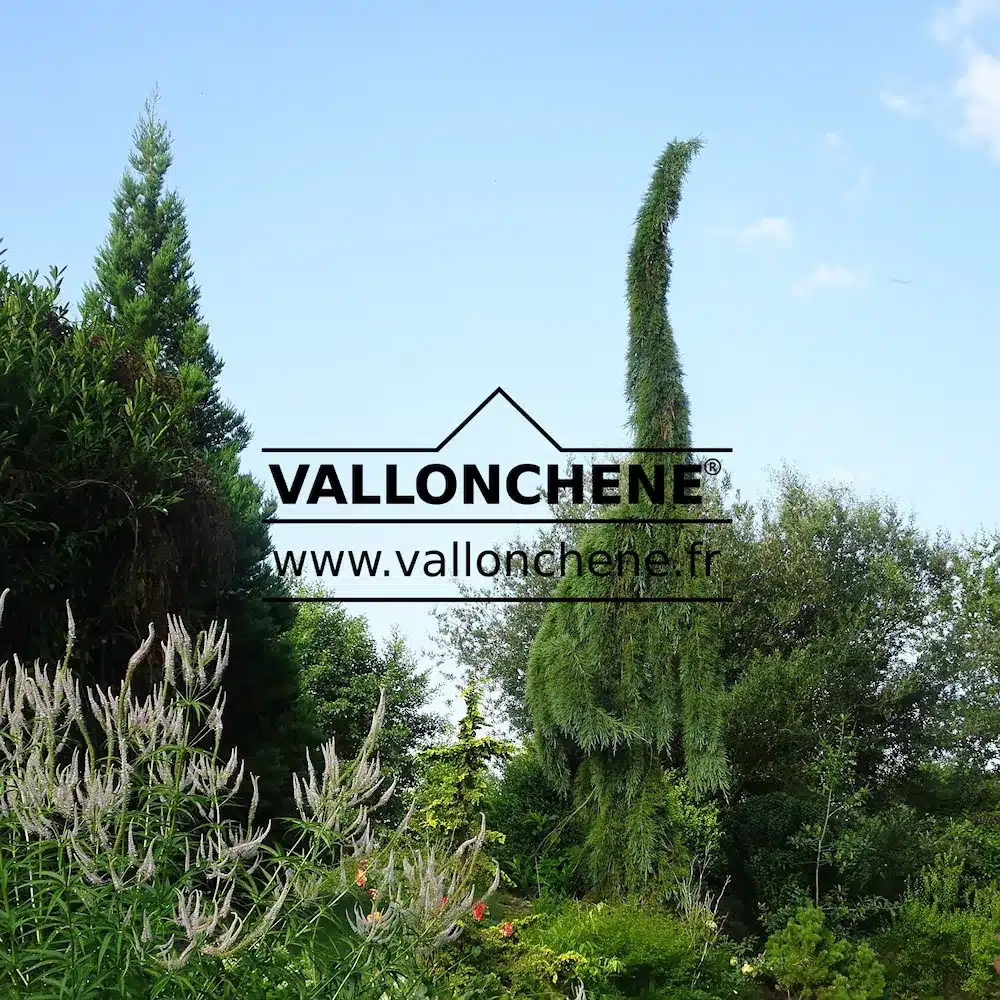
The SEQUOIADENDRON giganteum ‘Pendulum’ is probably one of the most spectacular trees that can find a place even in small gardens. It is also commonly called the weeping giant sequoia.
Indeed, it occupies an extremely small surface area. Its trunk literally twists toward the sky while its branches weep vertically down along it. Its silhouette can sometimes resemble fantastical animals or simply horse manes (see photos). No two specimens will ever look alike, as each plant develops its own unique appearance.
Even though the term “giant sequoia” might frighten some, be aware that the S. giganteum ‘Pendulum’ grows much slower than the species type. As a result, it will always remain much smaller and will rarely exceed 6 meters in height.
Furthermore, its narrow width of 1 to 1.50 m greatly reduces its wind resistance. Additionally, it is important to note that SEQUOIADENDRON possess an extraordinarily reliable root system. This makes them extremely resistant to storms.
Finally, this fabulous plant provides a remarkable architectural element in any season, and particularly in winter.
History and Origin
The indigenous peoples of North America knew of the SEQUOIADENDRON giganteum for millennia. Nevertheless, the Western world only discovered their existence in 1852. A grizzly bear hunter named Augustus T. Dowd discovered these fabulous trees in the Sierra Nevada mountains of California.
This triggered a true sequoia fever. Botanists and nursery owners all over Europe desperately sought to obtain seeds of this tree. These were sent primarily to the British and the French.
Then, in 1863, at the Lalande nursery near Nantes, a seedling stood out by growing in a strange way. Instead of discarding it, the nursery recognized its artistic and avant-garde quality. They then propagated it by grafting to stabilize this variation. The SEQUOIADENDRON giganteum ‘Pendulum’ was born!
The French botanist Élie-Abel Carrière described this cultivar for the first time in 1867 in his work entitled Traité Général des Conifères (General Treatise on Conifers).
How to plant and care for SEQUOIADENDRON giganteum ‘Pendulum’ ?
The Planting
As a prehistoric plant, it is certainly very resilient. However, to give it the best chances of successful establishment, consider the following points:
- Find it a spot in full sun or partial shade.
- The location can be cool to moist, moderately damp, or dry.
- This plant tolerates light, normal, heavy, or even very heavy soil with an acidic, neutral, or alkaline pH.
- For proper preparation of the planting hole, we have designed specific instructions available here.
The Caring
All newly planted trees require regular watering during the first two years, and particularly during dry spells. Of course, watering should not take place during the winter period. You can also read our tips on how to water properly and save water here.
Normally, this plant requires no pruning. It generally gets along very well on its own. If you still wish to prune it, do so in March before the new growth starts.


 7/7 from 8am-8pm


 Ask for a photo
Reviews
There are no reviews yet.